Every enterprise commerce leader faces the same pressure: customers want faster pages and better experiences, but replatforming is risky. Discover how we modernize HCL Commerce using Next.js and Spring Boot without starting over.
Every enterprise commerce leader faces the same pressure: customers want faster pages, better mobile experiences, and personalized content. The board wants growth without a risky, multi-year replatforming project. The technology team wants to ship improvements weekly, not once a year.
At Dvanta Technologies, we believe the answer for most HCL Commerce customers is not to replace the platform. It is to change where the boundaries sit. Keep the commerce engine that already runs your business. Put a modern experience layer in front of it. Add a clean service layer in between. This architecture—using HCL Commerce, Next.js, and Spring Boot—makes business sense.
The Real Problem is Not the Platform
HCL Commerce is a strong platform handling catalog, pricing, promotions, contracts, inventory, orders, and complex B2B rules at an unmatched scale. That logic is an asset.
The actual problem is the tightly bound customer-facing layer. In older implementations, the storefront, business logic, and integrations are too closely connected. A small change to checkout can mean a full release. But customers expect speed and agility. How do we let the customer experience move fast while keeping the commerce engine stable?
The Approach: Separate What Changes Often
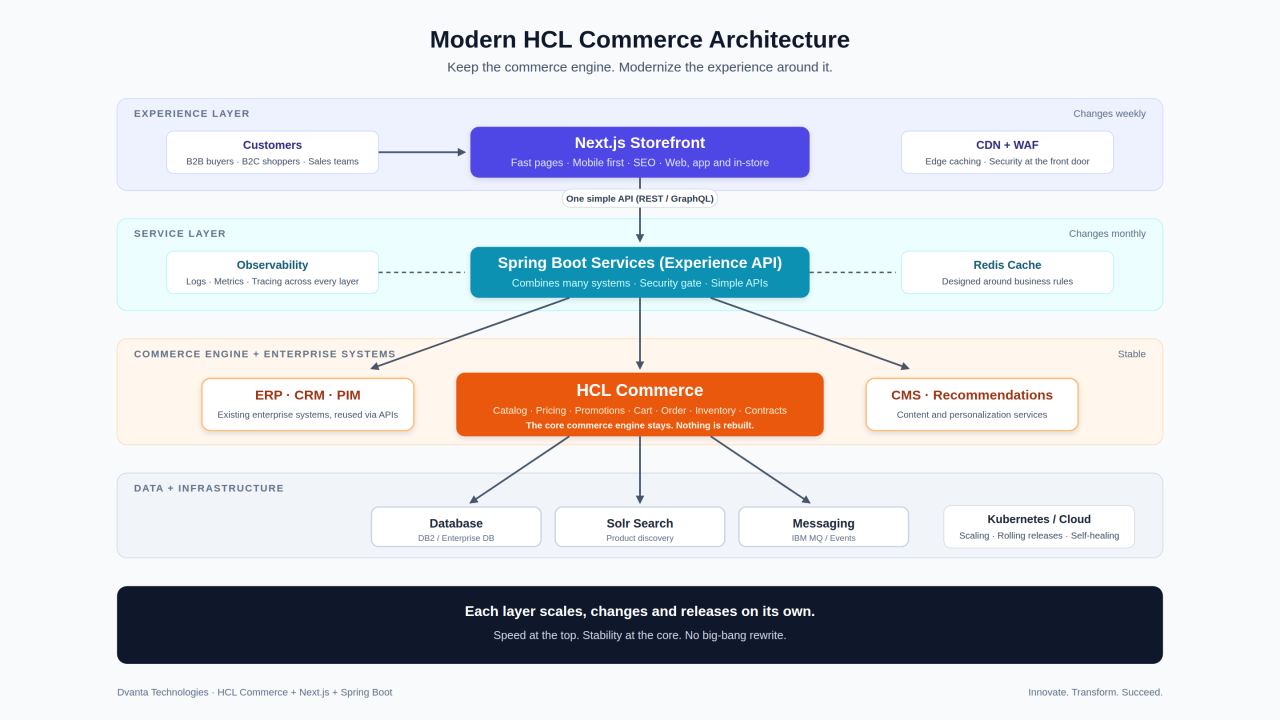
The architecture is simple: Headless flow with Next.js -> Spring Boot -> HCL Commerce.
Key Insights & Implementation
- HCL Commerce stays the core:It handles catalog, pricing, promotions, and inventory.
- Next.js becomes the storefront:A modern web framework built for speed and search visibility.
- Spring Boot sits in the middle:The service layer that talks to HCL Commerce and other systems (ERP, CRM).
- Speed to Market:Front-end teams can ship improvements weekly without platform releases.
- Lower Risk:No big-bang cutover. Modernize journey by journey.
- Protected Investment:Years of logic and integrations are reused through APIs.
- Better Security:Backend systems are never exposed directly to the browser.
- Operational Clarity:Modern monitoring shows exactly which layer is slow.
- Caching must respect your business rules, especially in B2B.
- Do not rebuild commerce logic in the frontend.
- Security must be enforced in the service layer, not just the browser.
- Observability is not optional.
“Enterprise engineering isn't just about modern technology. It's about measurable business outcomes and operational resilience.”
Results
What the fixes changed, measured before and after.
What This Means for the Business
A Few Things to Watch
How to Phase It
We recommend a sequence of small wins rather than a single large program. Start with the Spring Boot service layer, bring in Next.js for specific journeys (like product detail or cart), add performance operations, and continue one component at a time.
Modern commerce is not about replacing everything. It is about drawing the right lines between stable systems and modern experiences.